
Investment Portfolio Losses Hit $200,000. Is it Time to Panic or Buy More?!
July was a terrible month for investing for our household.
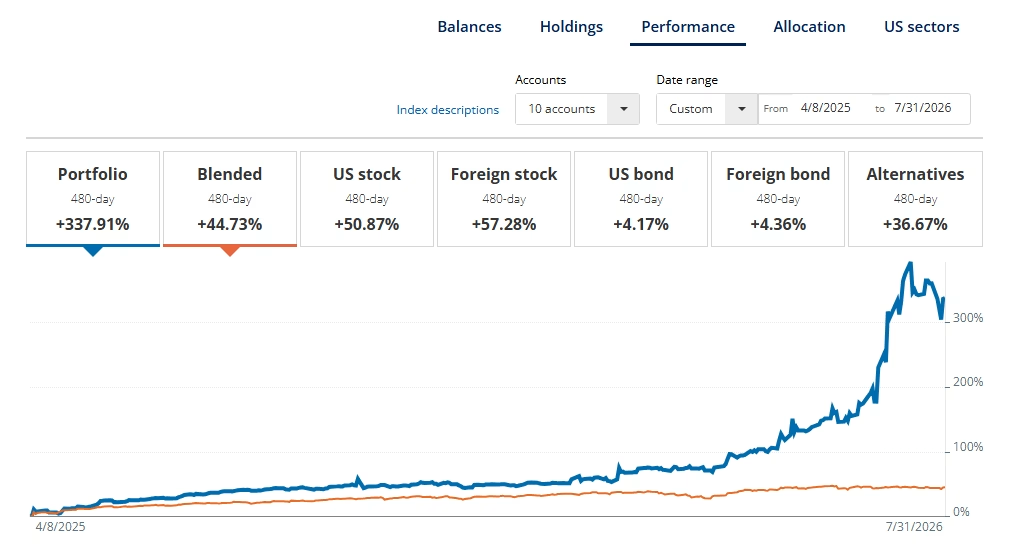
We dropped an easy 12 percent from our $1,750,000 high. I had a feeling but didn’t react fast enough to offset our semiconductor investments. To make matters worse, I kept buying back into the proverbial dip. So what happened? But before we get to that, we are still ahead of our $1.29 million total investment portfolio back on December 31, 2025. This puts us on pace to recapture some of the highs and end around $1.85 million by year’s end.
So what’s the cause of the drop? A perfect storm of that one guy (Michael Burry) who keeps saying we are in an AI bubble, South Korea’s investment gambling, and the Federal Reserve keeping rates the same. The latter was expected; however, most retail investors wanted an interest rate cut. The market and consumer spending are still too high for that. We still have at least $1 billion in tariffs to refund to companies like Amazon and our president’s temper to deal with.
I took my mandatory rental cleaning trip, which took a lot of energy and a 12-hr flight delay. Restaurant prices are disturbingly high since labor and supplies are costing more. We spent $75 on pizza and drinks, $150 on great barbecue, and $30 for two drinks at the movie theater. Yep, prices are indeed too high to step outside casually. Be careful about setting the AC too low indoors since it’s taxing on the utility bills as well. Think twice.
For now, it seems like we are all in for a wild ride. As of now, we are licking our wounds and praying for our neighbors (global and domestic).
Table of Contents
The Real Financial Recap for July
July featured a choppy equity market and a dramatic rotation into value stocks, with the S&P 500 essentially flat (-0.06 percent). Escalating Middle East tensions spiked oil prices by roughly 20 percent, while technology suffered, driving value stocks to strongly outperform growth. Meanwhile, the 30-year U.S. Treasury yield peaked above 5.27 percent.
Other notes:
- High-growth technology stocks took a major hit, with semiconductors dropping 20 percent.
- Value sectors like Energy and Financials led the rally, benefiting from higher commodity prices and a robust Q2 earnings season for major Wall Street banks.
- International markets recorded modest gains, outperforming domestic large caps.
- July employment report was surprisingly soft, with an unexpected decline in non-farm payrolls of 23,000.
If we make it through, financial markets are expected to show continued, AI-driven equity gains alongside volatility tied to energy prices and central bank policy. The S&P 500 is projected to finish between 7,600 and 8,000, supported by an estimated 20-30% surge in corporate profits, though lingering inflation means elevated interest rates are likely to persist.
How Investments Add to Your Wealth
Assuming metrics hold, the median US household wealth should be around $195,000. The Federal Reserve Survey of Consumer Finances (2025) due in October should provide more insight. Of that total, nearly 49% is home equity ($95,550). By contrast, their stock position hovered around 15% ($29,250). That’s not a good thing. To be financially efficient, your home equity portion should not exceed 30%. Why? The main reason is liquidity.
Most people aren’t likely to sell their home, especially if it’s paid off. Doing so would only lead you to find a new way to pay for housing (again).
In 2024, Business Insider found that most baby boomers are struggling to find affordable housing to downsize into. To avoid this costly future mistake, you need to evaluate your total wealth sooner rather than later. Your wealth should be divided as follows: 44% in equities and mutual funds, 17% in Real Estate, 6% in pensions and retirement funds, 17% in businesses, and 16% in other assets.
From 2020 to 2025, the S&P 500 returned 92.06%. Over the same period, the average annualized real estate return was 26.72%. While it’s not a competition between owning a home and stocks, the average annualized difference of 13% has an oversized long-term impact. Over time, the goal is to own both and split them in a way that you win. This is even more important as annual inflation erodes our wealth by around 4-5%.

Before we jump ahead again
For those new to the term “wealth,” it’s synonymous with net worth. Net Worth is equal to your (total) Assets minus (total) Liabilities. A simple definition is what you own vs what you owe. The best way to fix your household wealth equation is to:
- Spend Intentionally (on the stuff you need and truly love),
- Increase your income (when and where possible), and
- Invest the difference (in owning quality assets).
The investment component is fun since you can mix and match. You can invest in improving your soft skills, technical skills, or education. This would add to your innate human capital, i.e., Confidence, Focus, and Charisma. You can also invest indirectly through your 401k (or equivalent) and/or directly in the stock market. The goal here is to add to your financial stability, which in turn converts “No” to “Yes”. Additionally, this may include investing in valuable networks, i.e., relationships, organizations, etc. There you have it; those are the supposed secrets of the wealthy.
Those secrets helped my family’s net worth go from negative $155,000 to nearly $2.5 million in 13 years.
Reflecting on Simpler Times
In July 2016, I went on my first solo trip to Brazil for the Olympics. While it was intimidating, it pushed my boundaries mentally. So much so that I purchased a Condo (October 2016). I now realize how pivotal and transformative every moment is. Each decision compounds into the next good decision. Future opportunities are in part a function of your wealth and vice versa. Any potential success you see today is based on a myriad of choices, hard work, heartaches, and even tougher calls.
While most people didn’t believe me at first, with time, it became apparent that it’s not something you can force on people. They either want to be wealthy and stress-free, or they don’t. It’s not even about the money. Your investments are a function of ‘Time,’ the most limited asset you own. All we can do is share every tip, tool, and strategy so that you can make the best of your time.
You can’t say we never tried to help.
What’s it like on our end?
Through the endless motions of the market, we kept investing. Our Investments are down almost $228,000 for July. It’s nearly biblical out here; however, we are up over $200,000 in gains in our combined portfolios for the year. The long-term strategy pays off, even if the pain train is coming.
Prices are up. Eating dinner is now close to $225 in the DMV. Just hanging out for a quick cafe turned into an $80 fee. Tipflation is causing us to stay home; it’s not fun enough outside. To compensate, the average American will have to make a tough choice. You can either change your financial habits or be forced to change. Most are abandoning the movie-going experience altogether.
It’s too expensive outside.
My wife and I suggest that you get off the Hedonic Treadmill. It’s no fun spending more money, hoping for a raise, and only to spend more money again. With all of that said, this article will showcase the TNFG monthly Net Worth Breakdown for July 2026, where making money makes sense. In addition to our household wins and losses, we always drop useful financial nuggets and aha moments that might help you along your financial freedom journey.
What a long intro this month.
A Million More Mental Problems
Recap on this season of our lives. Post-pandemic is churning out mental health issues. The world is struggling to keep up with wealth inequality. Europeans are fighting over air conditioners. Check with your friends as we cope with another global issue. Money is dwindling for food, gas, and utilities. It’s as if we stumbled on the struggle multiverse timeline.
As difficult as it may seem, we’ve been in this staggered lifestyle for almost five years. And it hasn’t been easy on most people. The best way to cope is to start with a 5-10-20-year plan. Most of our problems are vested in the idea that we aren’t living with any true purpose. We are waiting for things to merely happen to us and for us. It’s the entitlement matrix.
You have to break free and create your own story. I don’t value labor, so we are headed for the financial freedom exit.
Shifting Post July to the 2nd Half of the Year
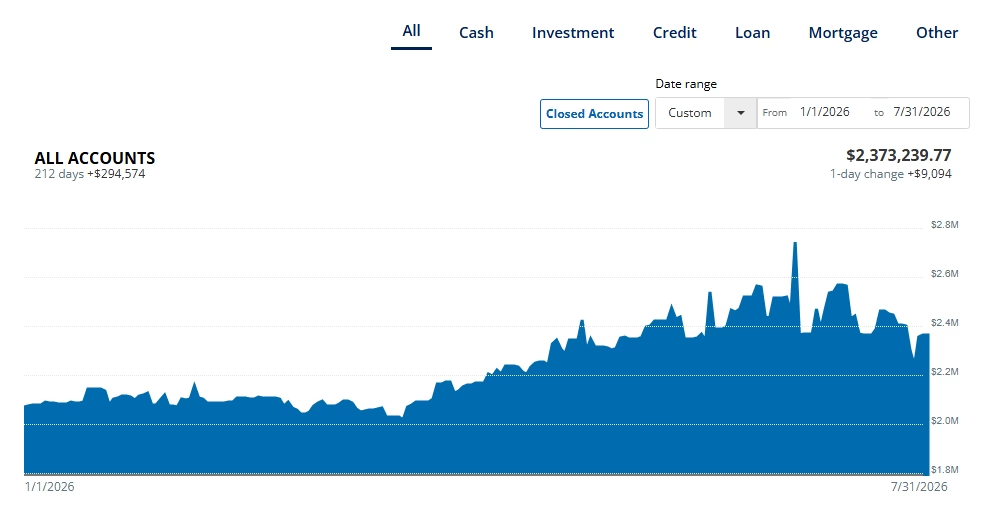
Hardcore Planning Season from July to December
Day by day, it might seem like a hurdle, but wealth is counted in the long term. To stay focused, we are moving forward with renovating our current home and purchasing a new one in retirement. As such, we are investing while paying off debt.
The goal by the end of 2026 is about +$150,000 net worth growth (to hit $2.5 million). So far, this year has had more misses than hits. The 2020-2021 investing cycle was easier by comparison, so the wins come harder and are way more deliberate.
At this stage, it’s all about holding on to big wins in 2027 and nasty losses in 2028. 2026 is more offense than defence; a great risk assessment exercise. I expect a chaotic finish in Q4; the market will likely settle at around +18% for the year.
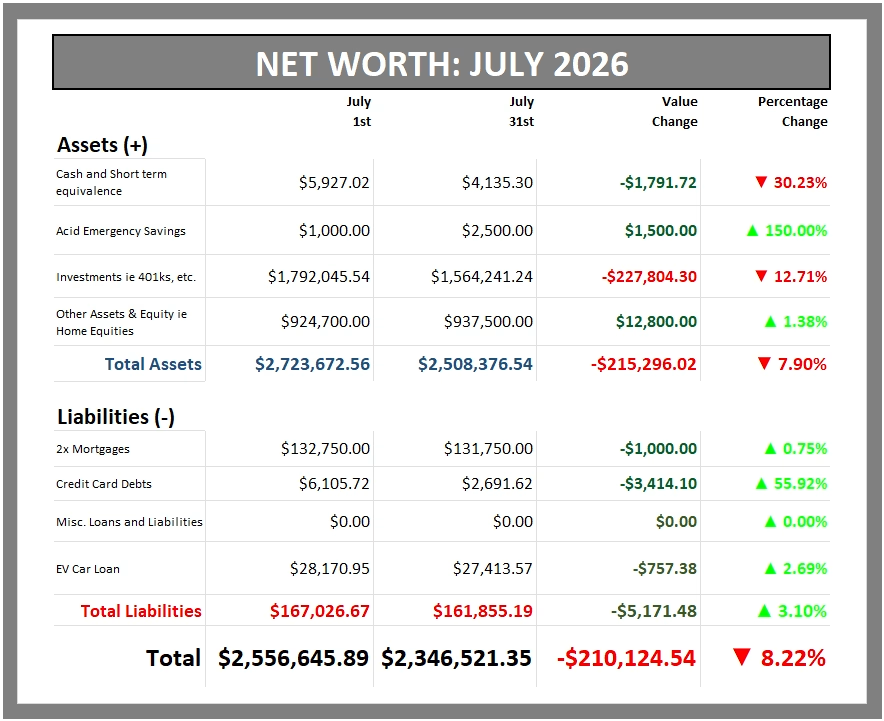
Here’s Our Monthly Net Worth Summary Overview:
So What Happened?
Our assets decreased by 7.90%. This resulted in an overall net worth decrease of 8.22%. I’m just happy that the bleeding stopped just a little shy of $250,000 losses. It’s a blink, and you might miss the next run-up.
For now, don’t anticipate good times. It’s more likely that there will be a slight drop in mid-August and again in October. This will reflect a drop in spending across the board. Companies are expected to dish out discounts and sales for Black Friday. The recession is once again cancelled.
Either way, my wife and I are shifting to:
- Back to stacking 15% worth of investment cash for future opportunities,
- Consider shifting asset allocations with more Utilities + Energy,
- Considering buying more shares of stocks that hit a record low (-30%), and
- Rebalancing where needed.
Our Expenses for July 2026
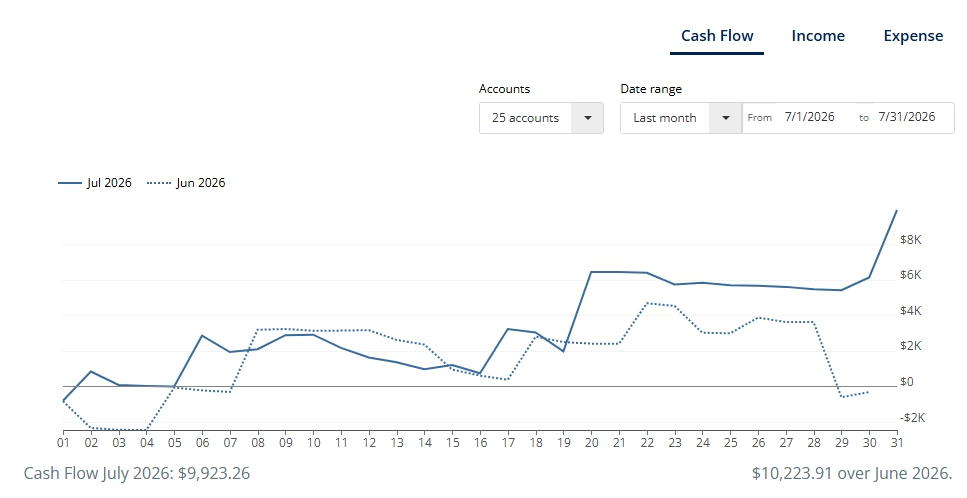
FIRE Cash Flow for July 2026
With the Peru trip coming up in October, time to count macros and decrease luxury eating because over $1,000 for Food and Dining is ridiculous. Let’s go over our July cash flow. It’s essential to note that we aren’t on a strict budget per se; we typically spend around $5,000 per month.
We use the Net Max Budgeting method, which allows flexibility in how we spend. As long as there is $3,500 in our checking account to start the next month’s expenses, we are covered. We will be pushing that threshold to $5,000 by year-end 2027. After that, we pay expenses and invest the difference.
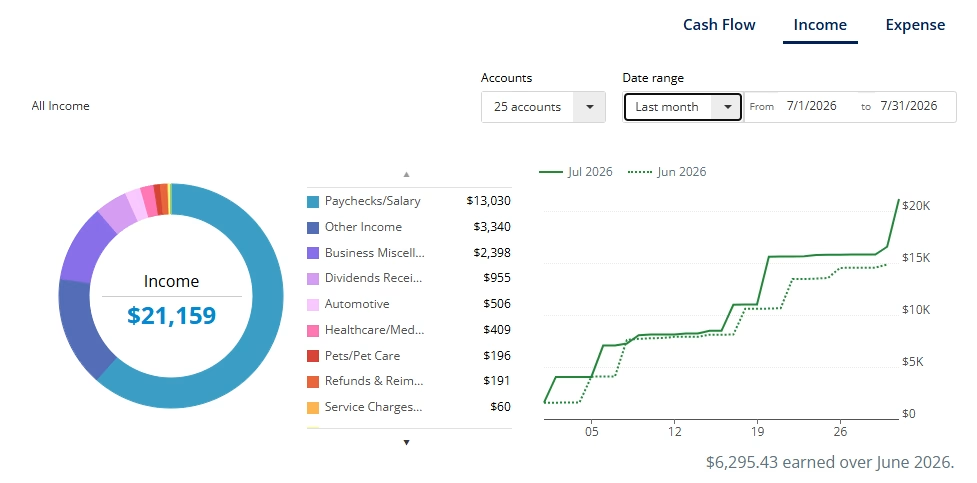
Income:
My wife and I are mid-tier professionals living in the Washington D.C. area. Around these parts, they pay pretty well. We pull in about $257,000 gross salary (combined). Our take-home is around $12,000 per month after deductions. We pulled an extra $1,500 per month from our rental property. Net of expenses, it’s closer to $150 per month. Add in that extra $1,566 per month in tax-free VA benefits, and we are cooking.
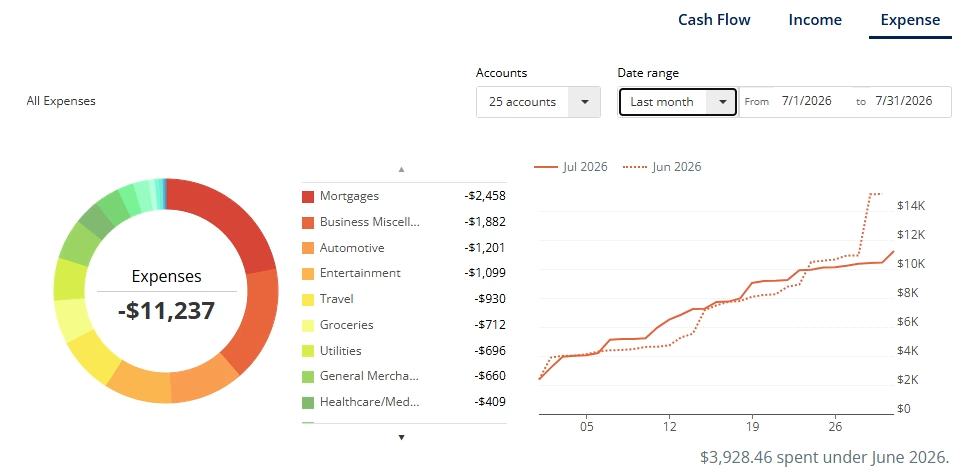
Expenses:
Most household expenses comprise over 70% of housing, transportation, and food. We manage things differently. While financial influencers opt for paying off debt or cutting down small expenses, we keep the big-ticket items smaller.
Our total housing (including utilities) cost peaks at 20% (excluding the rental property). The trouble zone is our auto, which comes out to 18%. The average total food cost monthly is around 11%. Our big three numbers are 21% less (a cash value of $19,000). Every dollar counts.
Those auto expenses are kicking our butts for the 2023 car. The car insurance came in at $860 with the monthly car loan of $893. At least our grocery bills seem reasonable this time at $1,000 since we front-loaded the first week of April. The flight for the rental property is taxing up, but it can’t be helped during a turnover year.
What is the Next Step beyond July?

What’s the deal for August?
We are headed ‘South’ (Rental repair again). It’s time for cleaning, HGTV with no cut scenes. Still a much-needed family recharge time for me. Brownie (our dog) will be there to supervise and provide security.
The world is getting smaller, so why not travel? With money getting tight, travel domestically for great bargains. I’m still hoping Google Maps acknowledges me with money; we have over 250 million views. That’s got to be worth something one day.
Beyond that, here are our overarching goals for 2026:
- Keeping our expenses where they should be by “Not equating happiness and social acceptance based on the money you spend.“
- Hold on to our recession-proof investment strategy through 2028.
- Get to $30,000 in M1 Finance, focusing on Growth and Dividend Income that generates at least +$3,000 in passive income by year-end. Check out the portfolio in real time. If you like the platform and want to start investing, I have the $10 for $10 referral if you need it – https://m1.finance/SYdqDJ2SyADC.
- Shooting for a sustainable $2 Million Investment Portfolio by April 2027.
- To help monitor your savings, cash flow, net worth, investments, retirement, and more for free with Personal Capital. Now known as Empower, a name change similar to Twitter going by “X.”
- Sign up with my link & get a $20 Amazon gift card. *Terms apply. https://pcap.rocks

About Author